Who can enter:
Children ages 5-12 in the United States. A parent or legal guardian must complete the submission.
Competition
Current campaign details will appear here when available.
Checking whether the competition is open…
Children ages 5-12 in the United States. A parent or legal guardian must complete the submission.
Prize details will appear here when the first campaign is configured.
You’ll need the parent email, the child’s first name and age, state, and the artwork image. The full legal terms, privacy notice, submission license, and content policy are linked below.
Enter now
Fill this out, upload the artwork, and we’ll guide you through the rest.
After you submit, we’ll send a quick email to make sure we can reach a parent or guardian.
Once that email is confirmed, the entry is officially in.
We sent a note to the parent email address. Click the link in that email, or enter the 6-digit code here.
Once you confirm the email, this entry is all set.
If you have not received the email yet, click Resend email and we will send a fresh one.
Enter the parent email address to review entries you have already submitted.
We sent a 6-digit access code to your email. Enter it below, or use the link in that email.
When I was 17 and auditioning as a piano major, I had only performed in recital once and had never faced a formal jury. Each school was a different environment, and I was unprepared for how much those settings would affect my focus.
At one audition, I began the opening of Beethoven’s Waldstein Sonata when someone behind me dropped a pen in a quiet passage. That brief sound hijacked my attention, and I don’t remember the rest of the audition. Other auditions were in cavernous rooms with unfamiliar acoustics or lighting, or on a large stage with the jury barely visible in the distance. I had practiced the repertoire exhaustively, but I had never practiced performing under disruption.
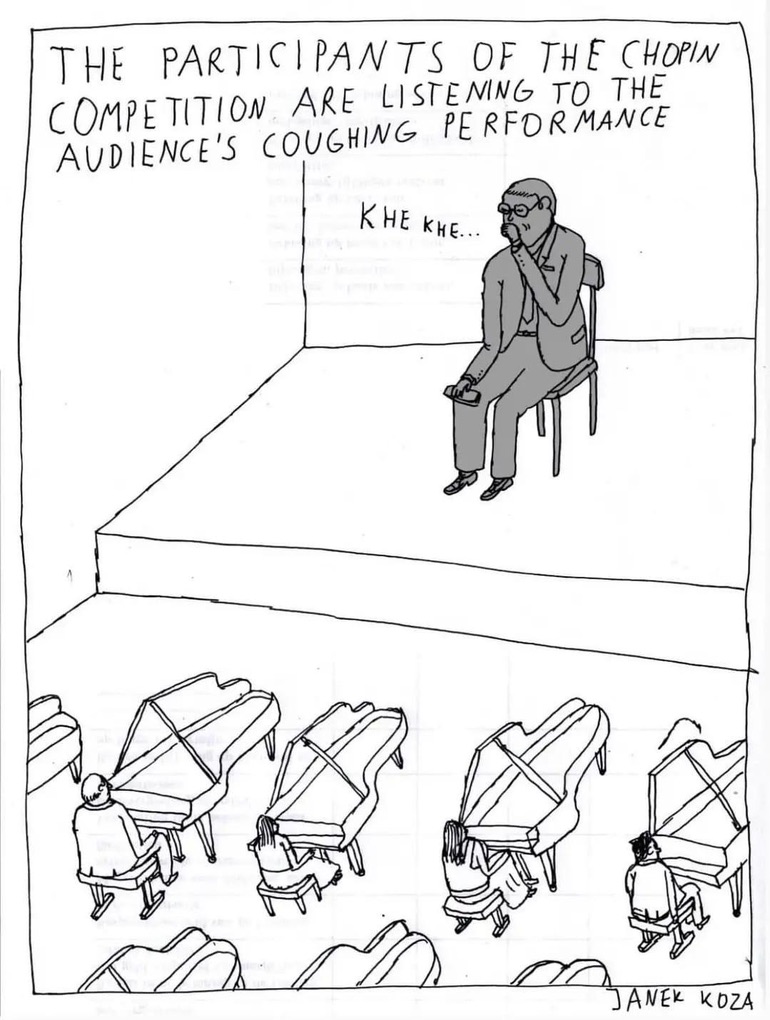
That realization stayed with me. On October 13, a friend showed me a cartoon by Janek Koza of Chopin Competition participants listening anxiously to audience coughing. It captured, with uncomfortable accuracy, what every performer recognizes: small interruptions can feel overwhelming under pressure. I started building a demo for the app that same day.
I have spoken with many teachers over the years and heard the same concern. The practice room can be controlled; the stage is not. It takes time to build the kind of focus that holds when the room doesn’t cooperate.
If any of this feels familiar, Nerves of Steel is here when you’re ready to rehearse the real thing.